


Muay Wanorn: The Monkey Style of Muay Boran


When most people think about Muay Thai, they think of round kicks, knees, elbows, clinching, and hard conditioning. They imagine the modern stadium fighter: sharp, disciplined, balanced, and dangerous. But behind modern Muay Thai there is an older world — the world of Muay Boran, regional styles, battlefield techniques, animal movements, mythological stories, and ritual.
One of the most fascinating parts of that older world is Muay Wanorn, often described as the monkey style of Muay Boran.
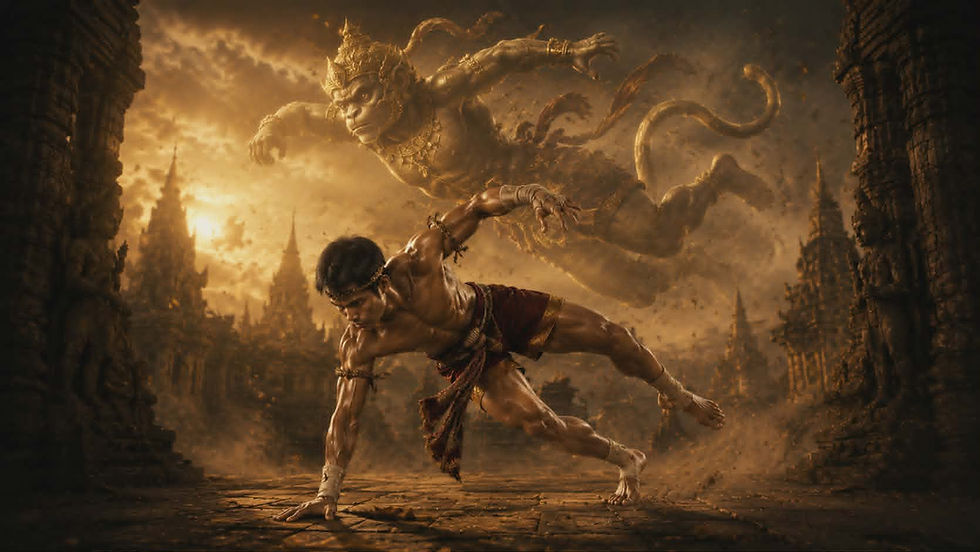
Muay Wanorn is not a modern competition style in the same way we talk about Muay Femur, Muay Khao, Muay Mat, or Muay Bouk. It belongs more to the traditional and cultural side of Thai martial arts. It is connected with the image of the monkey, especially Hanuman, the powerful monkey warrior from the Ramakien, Thailand’s version of the Ramayana.
Hanuman is not just a monkey in Thai culture. He represents courage, loyalty, intelligence, agility, mischief, and supernatural fighting ability. In Thai art and performance, Hanuman is a heroic figure: playful but dangerous, clever but powerful, unpredictable but always purposeful. Those qualities are exactly what make Muay Wanorn so interesting.
Kukrit Sor Nayarm (Light Shorts) was often called a Monkey Style figher.
What Does “Muay Wanorn” Mean?
The word Muay means boxing or fighting. Wanorn means monkey. So Muay Wanorn can be understood as monkey boxing or monkey-style fighting.
But this does not mean fighters simply imitate monkeys for entertainment. In traditional martial arts, animal movements are often used as a way of teaching body mechanics, rhythm, attitude, and strategy. The animal gives the fighter a model.
A tiger suggests power and aggression.A snake suggests timing and sudden attack.An elephant suggests strength and pressure.A monkey suggests agility, deception, awkward angles, jumping, rolling, and unpredictability.
Muay Wanorn is built around that monkey idea. It is playful, but it is not weak. It is evasive, but it is not passive. It uses unusual movement to confuse the opponent, create openings, and attack from unexpected positions.

The Hanuman Connection
To understand Muay Wanorn, you have to understand Hanuman.
Hanuman is one of the great heroic figures of Southeast Asian culture. In the Thai Ramakien, he is a warrior, a general, a trickster, and a symbol of fearless action. He can leap huge distances, change form, outwit enemies, and fight with tremendous energy.
This is why Hanuman appears so often in Muay Thai culture. You see him in tattoos, amulets, gym logos, shorts, Mongkhon designs, and traditional stories. Fighters are drawn to the image because Hanuman represents the qualities a fighter wants: courage, cleverness, agility, strength, and protection.
In Muay Boran, some techniques are named after Hanuman. These names are not random. They show how old Thai fighting methods were connected to stories, images, and cultural memory. A fighter was not only learning a physical movement; he was learning a way to express a fighting character.
Muay Wanorn takes this monkey-warrior character and turns it into movement.
What Makes Muay Wanorn Different?
Modern Muay Thai is usually direct. A fighter scores with clean kicks, knees, elbows, punches, sweeps, dumps, balance, and ring control. The techniques must work under stadium rules.
Muay Wanorn comes from a different mindset. It is more theatrical, more unpredictable, and more connected to Muay Boran. It may include:
jumping attacks
rolling movements
sudden angle changes
low-level movement
deceptive entries
awkward evasions
surprise counters
attacks that come from unusual body positions
This does not mean every Muay Wanorn technique is suitable for modern stadium Muay Thai. Some movements are better understood as traditional martial techniques, demonstration methods, or cultural expressions. But that does not make them meaningless. They show us how Thai martial arts were once much broader than the ring sport we see today.
Muay Wanorn reminds us that fighting was not only about strength and conditioning. It was also about imagination, rhythm, deception, and character.

Muay Wanorn and Wai Kru Ram Muay
One place where monkey-style movement may appear is in the Wai Kru Ram Muay, the traditional ritual performed before a Muay Thai fight.
The Wai Kru is the fighter’s way of showing respect to the teacher, the gym, the parents, the lineage, and the tradition. The Ram Muay is the dance-like movement that follows. In the old days, a fighter’s Ram Muay could reveal where he came from, who taught him, or what style he represented.
Some Ram Muay movements are inspired by animals, warriors, or mythological figures. A fighter might show the character of a hunter, a warrior, a bird, a tiger, or Hanuman. When a fighter uses monkey-like movement in the Ram Muay, it is not just decoration. It is a statement of identity.
It says: I am agile.I am clever.I am hard to catch.I will not fight in the rhythm you expect.
This is why Muay Wanorn is such a rich subject. It connects the physical, cultural, and psychological sides of Muay Thai.
Can Muay Wanorn Work in Modern Fighting?
This is an important question.
If someone tries to use dramatic rolling, jumping, or theatrical monkey movements exactly as seen in a demonstration, they may find it difficult in a modern fight. Stadium Muay Thai is unforgiving. The opponent is trained, balanced, and ready to punish mistakes.
But the principles behind Muay Wanorn can still be useful.
A modern fighter can learn from the monkey idea without copying every old technique literally. The useful lessons are:
UnpredictabilityDo not always attack in straight lines. Break rhythm. Change timing. Make the opponent hesitate.
AgilityDevelop the ability to move quickly, recover balance, and attack from different positions.
DeceptionShow one thing, then do another. Make the opponent react to the wrong signal.
PlayfulnessA relaxed fighter sees more. A playful fighter can create traps. Many great Muay Femur fighters had this quality.
Awkward anglesThe opponent trains to defend common attacks. Unusual angles can open opportunities.
So while Muay Wanorn may not appear directly in modern stadium Muay Thai, its spirit still exists. You can see it in fighters who are slippery, creative, and difficult to read. You can see it in fighters who tease, feint, escape, and counter from strange positions.
Muay Wanorn and the Old World of Muay Boran
Muay Boran is often misunderstood. Some people treat it as a fixed ancient system. Others dismiss it as performance. The truth is more complicated.
Muay Boran is a broad term used to describe older Thai fighting methods before the full development of modern ring Muay Thai. These methods included regional styles, self-defence techniques, battlefield ideas, ritual practices, and later reconstruction by teachers who preserved or revived old knowledge.
Muay Wanorn sits inside that world. It is not just “monkey tricks.” It is part of a larger tradition where movement, culture, combat, and storytelling come together.
This is one of the great differences between Muay Thai and many modern combat sports. Muay Thai is not only a sport. It is also a cultural art. It has music, ritual, hierarchy, respect, sacred objects, regional history, and symbolic movement.
Muay Wanorn shows that beautifully.
Why Muay Wanorn Still Matters
Some people may ask: if Muay Wanorn is not commonly used in modern fights, why does it matter?
It matters because Muay Thai is bigger than competition.
The modern sport gives us the stadium fighter: tough, technical, conditioned, and practical. But the older traditions give us the soul of the art. They show where Muay Thai came from. They show how Thai fighters once connected combat with culture, myth, ritual, and identity.
Muay Wanorn matters because it keeps alive the idea that martial arts are not only about winning. They are also about expression.
A fighter is not just a body throwing weapons. A fighter has character. A fighter has rhythm. A fighter has lineage. A fighter carries stories.
The monkey style reminds us that fighting can be clever as well as strong. It can be playful as well as serious. It can be beautiful as well as brutal.
Final Thoughts
Muay Wanorn is one of the most fascinating areas of Muay Boran. Inspired by the monkey and the great warrior Hanuman, it represents agility, deception, sudden attack, and unpredictable movement.
It is not the same as modern Muay Thai styles like Muay Femur or Muay Khao. It is better understood as an older traditional fighting expression — part martial technique, part cultural memory, part performance, and part strategy.
For today’s Muay Thai student, Muay Wanorn may not be something to copy directly in sparring or competition. But it can still teach valuable lessons: move differently, think creatively, use rhythm, deceive the opponent, and never become predictable.
Modern Muay Thai gives us the science of fighting.
Muay Wanorn gives us something older: the imagination of fighting.
And that is why the monkey style of Muay Boran deserves to be remembered


Comments